BMR Calculator
Calculate Your Basal Metabolic Rate
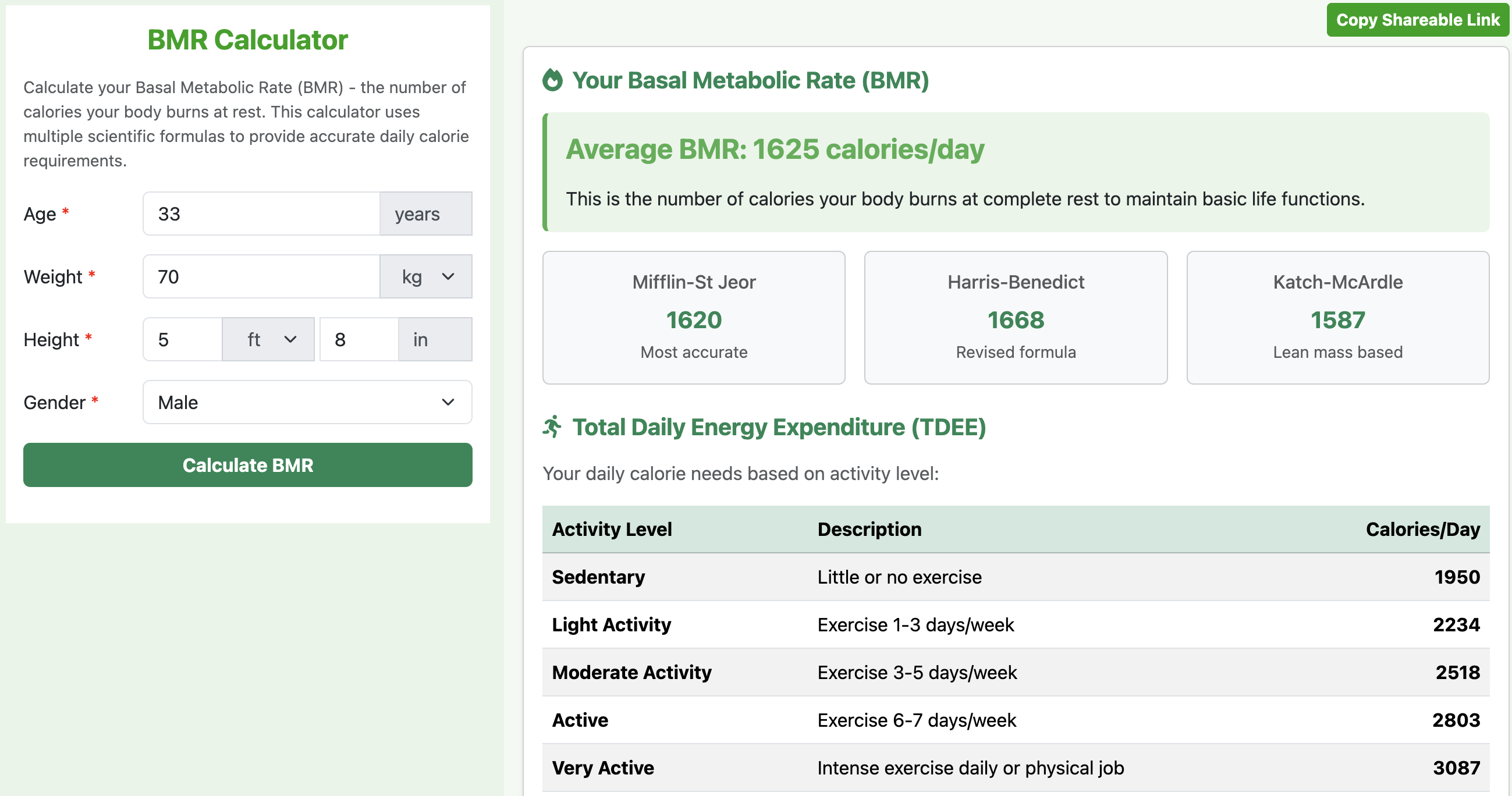
Enter your details in the form to discover how many calories your body burns at rest - the foundation for effective weight management:
Set accurate calorie targets based on your metabolism
Compare Mifflin-St Jeor, Harris-Benedict & Katch-McArdle
Get personalized daily calorie needs for your lifestyle
Based on validated metabolic rate equations
How It Works
Your Basal Metabolic Rate (BMR) is the number of calories your body needs to maintain basic life functions at rest. Combined with your activity level, it helps calculate your Total Daily Energy Expenditure (TDEE) - essential for creating effective nutrition and fitness plans.
Disclaimer: This BMR calculator is for informational and educational purposes only. It is not a substitute for professional medical advice, diagnosis, or treatment. Please consult a qualified healthcare provider for personalized health guidance.
What Is Basal Metabolic Rate (BMR)?
Your Basal Metabolic Rate (BMR) is the number of calories your body burns at rest to keep you alive. Even if you lie in bed all day, your body still consumes energy for:
- Breathing
- Circulating blood
- Regulating body temperature
- Cell growth and repair
- Brain and nerve function
- Hormone function
- Organ function
- Other vital bodily functions
Think of BMR as the minimum energy budget your body needs simply to exist.
Why BMR Matters?
Most people underestimate how many calories they burn naturally. In reality:
- 60–75% of total daily energy use comes from BMR
- Physical activity is usually only 15–30%
- Digestion (TEF) covers the rest
Understanding your BMR helps you make smarter decisions about fat loss, muscle gain, and long-term metabolic health.
How BMR Is Calculated?
There’s no single “perfect” formula. Instead, our calculator uses three of the most trusted scientific models, each with its own strengths.
-
Mifflin–St Jeor Equation
- Considered the most accurate for modern populations
- Based on weight, height, age, and gender
- Ideal for healthy adults
- Often used in clinical nutrition and diet planning
-
Harris–Benedict Equation (Revised)
- One of the oldest and most researched formulas
- Updated in 1984 to improve accuracy
- Slightly higher BMR estimates
- Useful for understanding historical BMR ranges over decades
-
Katch–McArdle Equation
- Uses Lean Body Mass (LBM) instead of total weight
- Highly accurate for athletes, lean individuals, and people with higher muscle mass
- Eliminates gender bias by focusing on metabolically active tissue
Each formula produces a different value because they emphasize different physiological variables. Providing all three gives you a more complete metabolic picture.
What Influences Your BMR?
Your metabolism isn’t a fixed number. Several factors influence it daily:
- Age: BMR gradually decreases as you get older due to changes in hormones, muscle mass, and organ efficiency.
- Muscle Mass: Muscle tissue burns more calories at rest than fat tissue. More muscle → higher BMR.
- Body Size: Taller and heavier individuals naturally burn more calories, even at rest.
- Gender: Men generally have higher BMRs because they have more lean mass and higher testosterone levels.
- Genetics: Some people are simply born with naturally faster or slower metabolisms.
- Hormones: Thyroid hormones, testosterone, estrogen, cortisol, and insulin all impact BMR.
- Body Temperature: A slight increase in temperature (exercise, fever, heat exposure) increases your resting calorie burn.
- Diet & Thermogenesis: Protein-rich foods require more energy to digest, slightly boosting BMR.
BMR vs TDEE: What’s the Difference?
- BMR = The calories your body needs at complete rest for vital functions.
- TDEE (Total Daily Energy Expenditure): BMR + activity + digestion.
TDEE gives you a realistic idea of how many calories you burn per day based on your lifestyle. Your activity multipliers help translate your resting metabolism into actual daily calorie needs.
Examples:
- Sedentary office workers: TDEE ≈ 1.2 × BMR
- Moderately active individuals: TDEE ≈ 1.55 × BMR
- Athletes/manual laborers: TDEE can exceed 1.9 × BMR
How to Use Your BMR Results?
BMR alone doesn’t tell you how much to eat - but it’s the foundation for calculating your calorie strategy.
- For Fat Loss: Eat 10–20% below TDEE but never below BMR for extended periods.
- For Muscle Gain: Eat 10–20% above TDEE. Focus on strength training and protein intake.
- For Weight Maintenance: Stay close to your TDEE. Use your BMR to understand your metabolic baseline.
Can You Increase Your BMR?
Absolutely. While genetics set the starting line, lifestyle determines the pace.
Proven ways to raise BMR:
- Build muscle (most effective method)
- Increase protein intake
- Stay hydrated
- Improve sleep quality
- Manage stress
- Avoid crash diets
- Stay physically active throughout the day
BMR FAQs:
- BMR = full rest under strict lab conditions
- RMR = resting metabolic rate in normal conditions